
Why the 7th Amendment Is More Important? The 7th Amendment guarantees the right to a jury trial in civil cases — and that matters more than most people realize.
It puts the power of judgment in the hands of ordinary citizens, not judges or corporations.
Without it, powerful institutions could resolve disputes behind closed doors, leaving everyday Americans with little recourse. It levels the playing field between individuals and large organizations in federal court.
The 7th Amendment is also one of the few constitutional protections that directly shields citizens in financial and property disputes — areas that affect real lives, real families, and real futures every single day.
Table of Contents
Quick Table
| Key aspect | What it means | Why it matters | Impact |
|---|---|---|---|
| Right to jury trial | Civil cases over $20 are entitled to a jury | Citizens — not judges alone — decide outcomes | Critical |
| Levels the playing field | Individuals can challenge corporations in court | Prevents powerful institutions from dominating justice | Critical |
| Protects financial disputes | Covers property, contract, and money cases | Shields everyday Americans in real-world conflicts | Critical |
| Democratic justice | Jury of peers reflects community values | Keeps civil courts transparent and accountable | Important |
| Limits judicial overreach | Judges cannot overturn jury fact-findings | Preserves the jury’s role as final fact-finder | Important |
| Federal court protection | Applies in all federal civil proceedings | Ensures consistent access to jury trials nationally | Informational |
| Ratified in 1791 | Part of the original Bill of Rights | Over 230 years of protecting civil justice | Informational |
Why the 7th Amendment Is More Important?
The 7th Amendment guarantees every American the right to a jury trial in civil cases — and that single guarantee carries enormous weight.
It means that when an individual goes up against a corporation, an employer, or an insurance company, a group of fellow citizens — not a single judge — decides the outcome. That distinction is everything.
Without this protection, wealthy institutions could tip the scales of justice in their favor. The 7th Amendment exists precisely to prevent that. It keeps civil justice democratic, transparent, and accessible.
In a world where power is rarely distributed equally, that matters deeply.
The moment it clicked for me
A few years back, a close friend of mine — let’s call her Diane — slipped on an unmarked wet floor at a big-box retail store.
Nothing dramatic on the surface: a twisted ankle, a torn ligament, and about six weeks of missed work. She wasn’t looking to get rich. She just wanted someone to cover the medical bills she didn’t have the money for.
The store’s insurance company low-balled her with an insulting offer. Diane, not knowing any better, almost accepted it.
Then her attorney mentioned three words: jury trial rights. Everything changed from that moment. The insurance company suddenly became much more willing to negotiate, and she eventually got a fair settlement.
The leverage that changed the outcome?
The 7th Amendment to the U.S. Constitution.
A 36-word clause that most people have never read, yet it’s one of the most powerful protections ordinary Americans have — especially against well-funded corporations and institutions.
“The moment a corporation knows you can put twelve of their potential customers in a jury box, their calculation changes entirely.”
So what does it actually say?
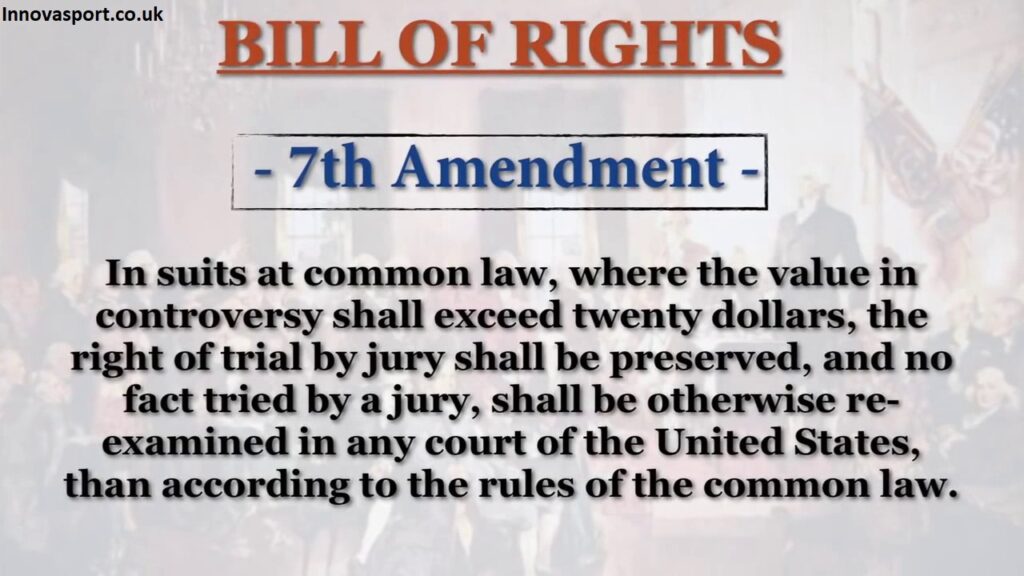
Here’s the full text of the 7th Amendment, ratified in 1791 as part of the Bill of Rights:
The 7th Amendment — Full Text
“In Suits at common law, where the value in controversy shall exceed twenty dollars, the right of trial by jury shall be preserved, and no fact tried by a jury, shall be otherwise re-examined in any Court of the United States, than according to the rules of the common law.”
In plain English: if you have a civil dispute — a lawsuit over money, property, personal injury, breach of contract — and the amount at stake is more than twenty dollars (a figure that hasn’t been updated since 1791, so in practice it covers almost everything), you have the right to have a jury of your peers decide the outcome instead of a single judge.
That second clause is often overlooked but equally important: once a jury has spoken, an appeals court cannot simply swap out the verdict and replace it with their own factual conclusion.
They can review legal errors, but they can’t override what the jury found as fact.

Why it matters for regular people
This might sound like legal housekeeping. It’s not. Here’s the fundamental truth about the American legal system: it is not a level playing field.
A large company has in-house attorneys, outside counsel, experts-for-hire, and years of experience navigating complex litigation. You, as an individual, almost certainly do not.
The 7th Amendment is one of the few structural mechanisms that partly levels that imbalance. Here’s why:
Juries are unpredictable for corporations. A judge is a trained legal professional who has heard thousands of cases. Over time, judges can develop patterns — corporate defense teams learn to read them.
A jury of twelve regular citizens is far harder to predict and, frankly, far more likely to empathize with a person who was genuinely harmed.
Jury trials are expensive for defendants too. Big companies know that a jury trial costs everyone money — including them.
That knowledge alone pushes more cases toward settlement, which means injured parties often get meaningful compensation without ever walking into a courtroom.
Juries represent community standards. What’s “reasonable” behavior in your town isn’t always what a distant judge thinks is reasonable.
A jury of your actual neighbors applies the community’s real values to the facts of your case. That’s a feature, not a bug.
Quick context
The Founders specifically included the 7th Amendment because they had seen, under British rule, how judges appointed by the Crown could rule against colonists regardless of the facts.
A jury of peers was, to them, a democratic safeguard — not just a procedural right.
How to invoke your 7th Amendment rights — step by step
Most people don’t realize that jury trial rights in civil cases aren’t automatic — you often have to explicitly demand them. Here’s how the process typically works:
File your civil complaint in federal or state court
The 7th Amendment directly governs federal civil cases. Most states have equivalent protections. When your attorney files the initial complaint, this starts the process. You need to be in the right court — small claims court, for example, typically doesn’t involve juries.
Make a written jury demand — and do it on time
Under the Federal Rules of Civil Procedure (Rule 38), you must file a written jury demand within 14 days after the last pleading related to the issue you want tried by jury. Miss this window and you may have waived your right. Your attorney should handle this, but if you’re self-representing, mark this deadline immediately.

Watch for arbitration clauses in contracts
This is the part most people miss. Many contracts — employment agreements, credit card terms, healthcare forms, app terms of service — include mandatory arbitration clauses that route disputes away from courts and into private arbitration. Courts have largely upheld these clauses. If you signed one, you may have already waived your right to a jury trial before any dispute even arose.
Participate in voir dire (jury selection)
If you do get to a jury trial, both sides have input in selecting jurors. Your attorney will ask questions and can challenge jurors for cause (bias) or use limited peremptory challenges to exclude jurors without stated reason. Understanding this process helps you get a fair panel.
Understand what the jury decides vs. what the judge decides
The jury decides facts: Did the defendant act negligently? Did they breach the contract? How much are your damages? The judge handles legal questions: What evidence is admissible? What instructions do the jurors receive? This division is crucial — and the 7th Amendment protects the jury’s factual conclusions from being overridden on appeal.
Real-world scenarios where the 7th Amendment applies
This isn’t theoretical. Here are the kinds of cases where ordinary people invoke — or benefit from — this right every day:
Personal injury cases: Car accidents, slip-and-falls, medical malpractice. If an insurance company is lowballing you, the threat of a jury trial is your most powerful negotiating tool.
Employment disputes: Wrongful termination, unpaid wages, workplace discrimination. A jury of working people often has strong intuitions about fairness in employment situations that a judge sitting in a federal courthouse may not share to the same degree.
Consumer protection: A company sold you something defective that caused harm. A warranty dispute went sideways. You were defrauded in a real estate transaction. These are exactly the disputes the 7th Amendment was designed to protect.
Landlord-tenant disputes: At the federal level and in many states, if your landlord has violated the Fair Housing Act or other federal statutes, you may be entitled to a jury trial on those claims.
Business disputes: Contract breaches between companies, partnership disagreements, intellectual property infringement — all can go to a jury under the right circumstances.
Common mistakes people make
Signing away your rights without reading the fine print. Binding arbitration clauses are in more documents than you’d believe. Read every contract you sign, especially employment agreements and any service you sign up for that involves money. Negotiating these clauses out is hard, but at least being aware of them is essential.
Assuming a jury trial is always the best strategy. Sometimes it isn’t. Jury trials are expensive, time-consuming, and emotionally draining. A skilled attorney might advise you that settlement or bench trial (just the judge) serves your interests better in a specific situation. Know your rights and then make a strategic decision.
Confusing the 6th and 7th Amendments. The 6th Amendment guarantees the right to a jury trial in criminal cases. The 7th covers civil cases. They’re different rights with different rules. People sometimes think that because they don’t face criminal charges, they automatically have no jury rights — that’s wrong.
Missing the jury demand deadline. As mentioned above, Rule 38 of the Federal Rules of Civil Procedure requires a timely written demand. Courts take this seriously. One missed deadline and you could lose the right entirely — even if you were fully entitled to it.
Thinking this only matters in high-stakes cases. The 7th Amendment applies whenever the dispute exceeds twenty dollars — which in practice means almost any civil case. Small business disputes, consumer claims, neighborhood property line arguments that end up in federal court — these all potentially trigger the right.
Threats to the 7th Amendment today
Here’s something that rarely makes the news: the 7th Amendment is quietly under sustained pressure, and most Americans don’t know it.
The biggest threat is the explosion of mandatory arbitration clauses in consumer and employment contracts.
The Supreme Court has consistently upheld these clauses, even class-action waivers, which means that in many situations, your contractual right to sue in open court — and have a jury hear your case — has already been signed away before any dispute arises.
The Economic Policy Institute has found that the majority of large U.S. employers now require employees to sign mandatory arbitration agreements as a condition of employment.
These agreements route all disputes to private arbitrators — often chosen by, and experienced with, corporate clients — rather than to public courts with juries of peers.
Critics call this a shadow legal system: one where decisions are made privately, precedents aren’t published, and the repeat-player advantage heavily favors corporations over individuals.
Supporters say it’s faster and cheaper. The truth probably lives somewhere in between — but the key point is that when arbitration replaces court, the 7th Amendment protections disappear.
“The Founders fought a revolution partly to keep power out of the hands of unaccountable decision-makers. Mandatory arbitration puts some of that power back there — just in corporate hands rather than royal ones.”
There are also ongoing debates about whether the 7th Amendment should be incorporated — meaning applied to state courts through the 14th Amendment.
Interestingly, unlike most of the Bill of Rights, the 7th Amendment has not been incorporated. That means state courts are not constitutionally required to provide civil jury trials, though most do so through their own state constitutions.
What it all comes down to
The 7th Amendment is never going to trend on social media. It’s not dramatic. It doesn’t come up in political debates the way the 1st or 2nd Amendments do.
But it’s working quietly in the background of thousands of courtrooms across the country, giving ordinary people a fighting chance against adversaries with far more resources.
When Diane walked into that attorney’s office after her fall, she had no idea that a sentence written in 1791 was about to change her negotiating position entirely.
That’s what rights are supposed to do — level the field, even when you don’t know they’re doing it.
Read your contracts. Know your deadlines.
And the next time someone asks you why a 230-year-old constitutional clause matters, tell them about the insurance company that suddenly got reasonable when twelve regular people entered the picture.
FAQs’
What does the 7th Amendment actually protect?
The 7th Amendment protects the right to a jury trial in federal civil cases where the value in dispute exceeds $20. It also prevents judges from overturning a jury’s findings of fact once a verdict has been reached.
Does the 7th Amendment apply to criminal cases?
No. The 7th Amendment applies specifically to civil cases. Criminal cases are covered separately under the 6th Amendment, which guarantees the right to a speedy trial and an impartial jury in criminal proceedings.
Why is $20 still the threshold after all these years?
The $20 figure was set when the Bill of Rights was ratified in 1791. While it has never been updated for inflation, courts have interpreted the amendment broadly to ensure jury access remains widely available in meaningful civil disputes.
Can the right to a jury trial under the 7th Amendment be waived?
Yes. Both parties in a civil case can mutually agree to waive a jury trial and have the case decided by a judge alone — known as a bench trial.
Why don’t all states have to follow the 7th Amendment?
The 7th Amendment has not been incorporated against the states through the 14th Amendment, meaning it applies in federal courts but states set their own rules for civil jury trials.
Conclusion
The 7th Amendment may not dominate headlines the way the 1st or 2nd Amendment does, but its impact on everyday American life is profound and enduring.
It stands quietly in the background of every civil courtroom — a constitutional guarantee that ordinary people have the right to be judged by their peers, not solely by the system.
Think about what that means in practice. When a worker sues an employer for wrongful termination, when a family takes on an insurance company after a denied claim, when a consumer fights back against a corporation — the 7th Amendment is the foundation beneath their feet.
It is what makes those battles winnable.
Without it, the justice system in civil matters could easily become a closed conversation between legal professionals, tilted toward those with the most resources and influence.
The jury trial requirement breaks that dynamic open and invites the community into the process.
More than 230 years after its ratification, the 7th Amendment remains one of the most democratic provisions in the entire Bill of Rights.
It is proof that the framers understood something essential — that justice must never belong only to the powerful.
About the Author