Why Is Portland Called “Rip City”? If you’ve ever watched a Portland Trail Blazers game, you’ve heard it — Rip City. The crowd chants it. The jerseys wear it. The city owns it.
But where did this now-iconic nickname actually come from? The answer isn’t a marketing campaign or a city council vote.
It came from a single, spontaneous moment during a 1971 basketball game — a half-accidental phrase shouted by a broadcaster that somehow stuck forever.
What started as an off-the-cuff call became the identity of an entire city. Here’s the wild, surprisingly simple story behind one of sports’ greatest nicknames.
Table of Contents
Quick Table
| Fact | Detail | Category |
|---|---|---|
| Who coined it | Bill Schonely, the Trail Blazers’ original play-by-play radio broadcaster | Origin |
| When it happened | February 18, 1971 — during a game against the Los Angeles Lakers | Date |
| What triggered it | A long mid-range shot by guard Jim Barnett went in unexpectedly, prompting Schonely to spontaneously shout “Rip City!” | Moment |
| Was it planned? | No. Schonely himself said it surprised him — he never used the phrase before and wasn’t sure where it came from | Spontaneous |
| How it spread | Schonely kept using it on air; fans adopted it organically over the 1970s as the Blazers grew in popularity | Adoption |
| 1977 championship effect | Portland’s NBA title that year cemented the nickname citywide — “Rip City” became synonymous with Trail Blazers pride | Legacy |
| City vs. team | Though born in basketball, “Rip City” is now used to describe Portland itself — appearing on murals, merchandise, and city branding | Culture |
Why Is Portland Called “Rip City”?
“I had been to dozens of NBA arenas before I got to the Moda Center. But nowhere did the crowd feel like they *owned* the name on the floor the way Portland did.”
The first time someone called me out for not knowing what “Rip City” meant, I was standing in a sports bar in Seattle — yes, Seattle — wearing a borrowed Trail Blazers hoodie and nodding like I totally understood the reference. I did not.
What followed was a twenty-minute education from a guy named Roy who had watched Bill Walton play in person. I’ve been obsessed ever since.
Portland, Oregon doesn’t have a football team. It doesn’t have a baseball team. What it has — what it has always had — is the Trail Blazers.
And with that team came one of the most accidental, accidental-yet-perfect nicknames in all of American sports: Rip City.
If you Google it, you’ll get the basic answer in about fifteen seconds. But the real story — the texture, the why-it-stuck part — takes a little longer to appreciate. Stick with me.
The Night It Happened
It was February 18, 1971. The Trail Blazers were in just their first season as an NBA franchise (they joined the league in 1970), and they were playing the Los Angeles Lakers at Memorial Coliseum.
Portland’s radio play-by-play announcer, Bill Schonely, was calling the game.
The Blazers’ guard, Jim Barnett, launched a long shot from well beyond what would later become the three-point line — back then there was no three-point arc, so this was just a wild, ambitious attempt from distance.
And it went in.
Schonely, caught in the electricity of the moment, blurted out what would become one of the most famous calls in franchise history:
“Rip City, all right!”
He’s admitted since that he had no idea where it came from. It wasn’t a planned catchphrase. It wasn’t workshopped by a marketing team or focus-grouped with season ticket holders.
It just happened — the kind of spontaneous verbal creation that only works when the moment demands it.
Quick Fact
Bill Schonely called Blazers games for 24 seasons, from 1970 to 1998. He became so beloved in Portland that he was nicknamed “The Schonz.”
The phrase “Rip City” is almost entirely his legacy — and one unscripted exclamation from 1971.
Why Did It Stick?
This is where it gets interesting, because a lot of broadcast catchphrases don’t survive the week, let alone the decades. What made Rip City different?
Part of it is Schonely himself. He used it consistently after that night — not every game, but enough that it became familiar. It wasn’t forced.
It came out naturally in moments of genuine excitement, and Portland fans started to associate that phrase with the feeling of something big happening on the court.
The other part is timing. The Trail Blazers were a young franchise in a city that had never had an NBA team. Portland fans were hungry for identity.
They wanted something to call their own. “Rip City” gave them that — a name that was weird enough to be memorable, energetic enough to feel like victory, and vague enough that it could mean whatever you wanted it to mean.
The Championship That Sealed It
The 1977 NBA Championship changed everything. The Blazers — led by Bill Walton, a player so dominant that season he won the Finals MVP — defeated the Philadelphia 76ers in six games. It was Portland’s first and, to this day, only championship.
The whole city erupted. And what did fans chant? What did signs say? What did the headlines scream?
Rip City.
After 1977, it wasn’t just a catchphrase anymore. It was a civic identity. A declaration. Something that belonged to Portland the way the Space Needle belongs to Seattle or Fenway belongs to Boston.
1970Year the Trail Blazers joined the NBA
1971Year “Rip City” was first uttered on air
1977Portland’s only NBA Championship
24Seasons Bill Schonely called Blazers games
What Does “Rip City” Actually Mean?
Honestly? Nobody knows for certain — not even Schonely. Over the years he’s offered a few different explanations, but even he’s acknowledged that in the moment, he wasn’t thinking about meaning at all.
One theory that gets tossed around: “ripping” through traffic or a defense was already basketball slang in that era. “Ripping” a shot — taking it with force and confidence — was common vernacular.
So “Rip City” might be read as a place where you play that way. Aggressively. Confidently. With zero hesitation.
Another theory, somewhat less romantic: Schonely had been using the phrase “Rip” informally in practice calls and it just surfaced under pressure. Language does that sometimes.
The brain reaches for something familiar when adrenaline takes over logic.
A few people over the years have tried to connect it to Oregon’s logging history — “ripping” timber, working the land.
That interpretation is probably more revisionist than real, but it’s poetic enough that Portlanders tend to like it.
Worth Knowing
Schonely himself has said in interviews that he sometimes told different stories about the phrase’s origin depending on his mood. He found it amusing that one unscripted moment became so mythologized.
“I honestly don’t know where it came from,” he said in one account. That uncertainty is part of what makes it great.
A Timeline of Rip City’s Evolution
1971
The Original Call
Bill Schonely spontaneously shouts “Rip City, all right!” during a Jim Barnett basket against the Lakers. No one plans it. No one approves it.
1977
The Championship Locks It In
Portland wins its only NBA title. “Rip City” becomes the civic rally cry. It’s on signs, T-shirts, and front pages across Oregon.
1980s–90s
The Drexler Era
Clyde Drexler keeps the franchise relevant. Rip City becomes shorthand for Blazers fandom in national sports media — even casual fans start recognizing the phrase.
2000s
The Brand Takes Shape
The Blazers officially embrace “Rip City” as part of their brand marketing. Merchandise, court design, social media — it’s everywhere.
2011
Schonely Returns
Years after his retirement, Schonely returns to public presence with the organization. The phrase gets a renewed spotlight as fans celebrate its 40th anniversary.
Today
City-Wide Identity
Rip City is printed on street murals, local businesses, apparel brands, and tattoos across Portland. It’s no longer just sports — it’s civic shorthand.
How Portland Made It Their Own
Here’s something outsiders sometimes miss: Portland is a weird city, and it’s proud of being weird. “Keep Portland Weird” isn’t just a bumper sticker — it’s a genuine civic philosophy.
Portlanders distrust corporate polish. They prefer things that feel earned, accidental, human.
“Rip City” fits that perfectly. It wasn’t engineered. It wasn’t the result of a rebrand consultancy charging six figures. It was a 50-something radio announcer having a pure moment during a basketball game in 1971. That’s the most Portland origin story imaginable.
I’ve talked to Blazers fans who grew up in the ’80s, and without exception they describe Schonely’s voice as the sound of their childhood.
They’d listen to road games on the radio, lying in bed past bedtime, waiting for that call. “Rip City” was the signal that something good just happened.
That association — excitement, pride, belonging — is what turns a catchphrase into an identity.
The Mistakes People Make About This Story
If you look this up online, you’ll find a few versions of the story that don’t quite hold up. Here are the things people get wrong most often:
Assuming it was the three-pointer. There was no three-point line in the NBA in 1971. The three-point rule wasn’t adopted until 1979. The shot Barnett made was impressive for its distance, but it counted for two points. The drama was the moment and the call — not a triple.
Thinking Schonely had a clear meaning in mind. He didn’t, and chasing a definitive etymology is a bit of a dead end. The phrase works precisely because it doesn’t have one locked-in meaning. It’s evocative, not descriptive.
Treating the 1977 championship as the origin. The championship amplified and cemented the phrase, but it didn’t create it. By ’77, “Rip City” was already six years old. The title just gave it weight it hadn’t had before.
Why It Still Matters
In an era where teams constantly rebrand, where nicknames get trademarked and monetized and turned into lifestyle collections, “Rip City” is a reminder of what happens when a community just decides something is theirs.
You can buy official Rip City gear now, sure. The organization uses it in their marketing. But it never feels corporate, because everyone in Portland knows the story — or some version of it — and they know the story is fundamentally human.
One man, one microphone, one lucky shot, one perfect burst of language.
When I finally visited the Moda Center for a game a few years back, I paid attention to the crowd during big moments.
Sure enough, when a Blazer hit a huge shot in the fourth quarter, the guy two rows behind me just yelled it — spontaneously, instinctively, the way Schonely probably did in 1971.
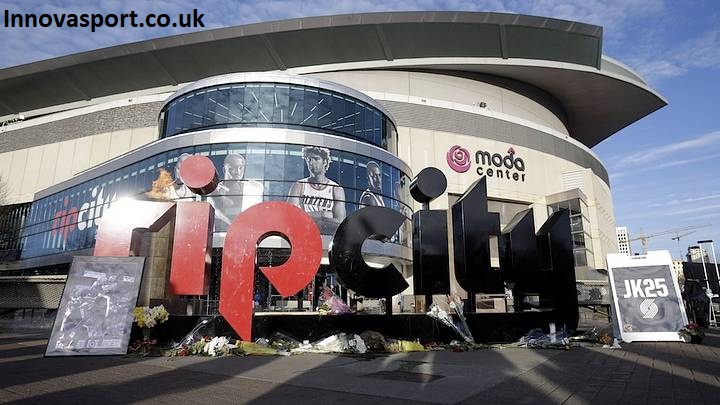
Rip City.
No announcement. No prompt. Just a man and a moment and a phrase that had become part of how he understood joy in a basketball arena. That’s fifty-plus years of emotional conditioning.
FAQ’s
Who invented the nickname “Rip City”?
The phrase was coined by Bill Schonely, the Portland Trail Blazers’ beloved original radio broadcaster. Schonely was the voice of the Blazers from the team’s very first season in 1970 and became as iconic to Portland basketball as the nickname itself. He called games for the team for over three decades, and “Rip City” followed him — and the franchise — every step of the way.
What exactly was happening when “Rip City” was first said?
It was February 18, 1971, and the Trail Blazers were playing the Los Angeles Lakers. Guard Jim Barnett hit a long, unexpected shot, and Schonely — caught up in the excitement — spontaneously shouted “Rip City!” on air. He later admitted he wasn’t entirely sure where the phrase came from. It wasn’t rehearsed, it wasn’t planned, and it wasn’t even repeated intentionally at first. It just stuck.
Does “Rip City” mean anything specific?
Not officially. Schonely gave varying explanations over the years — some suggest it evoked the idea of “ripping” through the net on a clean shot, while others think it was simply an expression of pure excitement. There’s no definitive meaning, which is part of what makes it so enduring. It means whatever the moment needs it to mean.
When did “Rip City” become bigger than basketball?
The phrase gained serious cultural weight after Portland won the 1977 NBA Championship — the only title in franchise history. That championship run turned the Trail Blazers into a citywide obsession, and “Rip City” became the rallying cry that united all of Portland. Over the following decades it migrated off the court and onto murals, storefronts, and city merchandise until it became shorthand for Portland itself.
Is “Rip City” officially recognized by the city of Portland?
While it isn’t an official municipal motto, “Rip City” functions as Portland’s unofficial identity marker. The Trail Blazers have embraced it fully in their branding, and it appears throughout the city in public art, local businesses, and community events. For many Portlanders, especially lifelong fans, it carries the same weight as any official civic symbol — maybe more.
Conclusion
Not many cities get their nickname from a single unrehearsed shout on a radio broadcast. But Portland isn’t many cities, and “Rip City” isn’t many nicknames.
What Bill Schonely accidentally invented on a February night in 1971 turned out to be something rare — a phrase with no fixed meaning that somehow means everything to the people who claim it.
It survived because the city gave it life. Through losing seasons and winning ones, through the championship glory of 1977 and the lean decades that followed, Portland kept saying it.
Fans passed it down. Broadcasters honored it. Eventually the city itself absorbed it, and what began courtside became something you’d find spray-painted on a wall or stitched onto a hat worn by someone who has never watched a single basketball game.
That’s the thing about great nicknames — they outlive their origins. “Rip City” is no longer really about Jim Barnett’s shot or Schonely’s voice or even the Trail Blazers, though it will always belong to all three.
It’s about Portland’s identity, its pride, and its stubborn insistence on being exactly what it is. Rip City, indeed.
About the Author