When 75% of Fortune 500 companies trust a single assessment to predict workplace success, you need to understand what makes it work. The Hogan Assessment has revolutionized how organizations identify talent, develop leaders, and build high-performing teams.
We’ll reveals what the Hogan personality assessment actually measures, why it outperforms traditional hiring methods, and how understanding your results can transform your career trajectory in 2026’s competitive landscape.
Table of Contents
What is the Hogan Assessment?
The Foundation
Created by Drs. Joyce and Robert Hogan in 1987, the Hogan Assessment revolutionized workplace psychology by focusing on what truly matters: how others perceive your behavior. Unlike traditional personality tests that measure self-perception, the Hogan questionnaire predicts your workplace reputation—the consistent patterns others observe when you’re at your best and under stress.
This fundamental shift from identity to reputation makes the Hogan evaluation uniquely powerful. Your self-image might tell you you’re collaborative, but your reputation reveals whether colleagues actually experience you that way. This distinction explains why the Hogan test achieves prediction accuracy rates that far exceed conventional screening tools.
Today, Hogan Assessments Systems serves clients across 56 countries, with translations in 47 languages. Major organizations including Coca-Cola, Microsoft, and the U.S. Department of Defense rely on these scientifically validated tools for critical talent decisions.
The Three Pillars of Personality Measurement
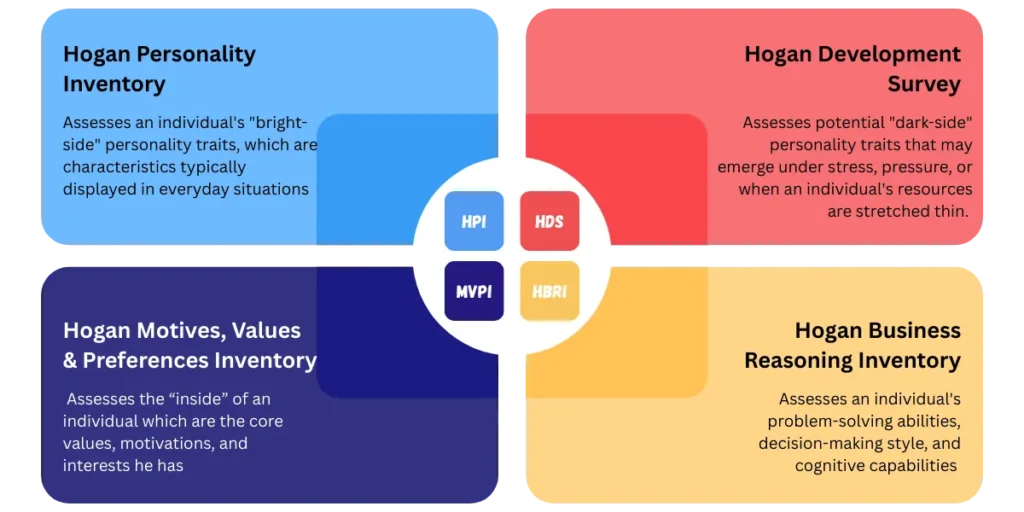
The Hogan personality test isn’t a single exam—it’s a comprehensive system examining personality from every angle:
- Hogan Personality Inventory (HPI) – The Bright Side: Measures your day-to-day strengths and how you perform when things are going well. These are the personality traits that help you build credibility, establish trust, and demonstrate competence.
- Hogan Development Survey (HDS) – The Dark Side: Identifies potential derailers—behaviors that emerge under stress, pressure, or boredom. These dark side personality characteristics can sabotage careers despite technical competence.
- Motives, Values, Preferences Inventory (MVPI) – The Inside: Reveals what drives you, what environments energize you, and where you’ll find cultural fit. Understanding these values predicts job satisfaction and retention better than any other factor.
Additionally, the Hogan Business Reasoning Inventory (HBRI) assesses cognitive problem-solving style, distinguishing tactical from strategic thinkers.
Also Read! Net Book Value Trends 2026: What Companies Are Saying
Why the Hogan Assessment Predicts Success: The Science
The Reputation Principle
Most personality assessments ask how you see yourself. The Hogan leadership assessment asks how others see you—because that’s what determines occupational success.
Research consistently shows that workplace performance depends on reputation, not identity. Your manager doesn’t promote you based on how you perceive your leadership potential; they promote you based on how consistently you demonstrate leadership behaviors others can observe.
This social performance model explains why the Hogan screening process achieves predictive validity coefficients ranging from 0.20 to 0.40—considered excellent in psychological assessment. When organizations use Hogan for pre-employment screening, they see 25-40% improvements in hiring quality compared to unstructured interviews alone.
Scientific Validation
The Hogan personality assessment stands on a foundation of over 400 validation studies spanning four decades. Built on the Big Five personality model—the most robust framework in psychological science—each Hogan scale correlates with specific workplace outcomes:
- Leadership effectiveness: Validity coefficient of 0.35
- Sales performance: Validity coefficient of 0.30
- Customer service quality: Validity coefficient of 0.28
- Safety compliance: Validity coefficient of 0.33
Meta-analyses aggregating thousands of participants confirm these predictions hold across industries, cultures, and job families. The scientific foundation isn’t theoretical—it’s derived from real workplace data showing who succeeds and why.
What Makes It Different
The Hogan exam incorporates validity scales that detect inconsistent answering patterns and impression management. Unlike assessments where “faking good” inflates scores, the Hogan system flags suspicious response patterns, ensuring authentic results.
Job-family specific benchmarks mean your scores aren’t compared to everyone—they’re compared to successful performers in similar roles. An optimal profile for a software developer looks different from an executive leader, and Hogan’s normative databases reflect these distinctions.
Most importantly, Hogan doesn’t just describe personality traits—it predicts behavioral tendencies. The assessment tells employers: “Here’s how this person will likely behave in your workplace.”
The 2026 Context
Remote and hybrid work has intensified demand for accurate behavioral prediction. When managers can’t observe daily behavior, they need assessment tools that predict performance risks and collaboration patterns across digital environments.
The current leadership crisis—with 60% of organizations reporting inadequate leadership pipelines—makes identifying leadership potential more critical than ever. The Hogan leadership assessment helps organizations spot high-potential talent before investing in expensive development programs.
Cultural fit prediction has become essential for retention. With average turnover costs exceeding 150% of annual salary, understanding whether candidates align with organizational values through the MVPI delivers measurable ROI.
The Four Hogan Assessments Explained
Hogan Personality Inventory (HPI) – The Bright Side
What It Measures: The HPI examines seven primary scales representing normal personality—the bright side personality characteristics that drive day-to-day performance:
- Adjustment: Emotional resilience, stress tolerance, and remaining calm under pressure
- Ambition: Drive for achievement, leadership initiative, and competitive energy
- Sociability: Extraversion, social confidence, and seeking interaction
- Interpersonal Sensitivity: Tact, perceptiveness, and maintaining relationships
- Prudence: Conscientiousness, dependability, and following rules
- Inquisitive: Curiosity, creativity, and openness to new ideas
- Learning Approach: Valuing education, staying current, and academic achievement
Each scale contains subscales providing nuanced understanding. For example, Ambition includes subscales for Competitive, Self-Confidence, and Leadership, revealing whether someone’s ambition manifests through competition or influence.
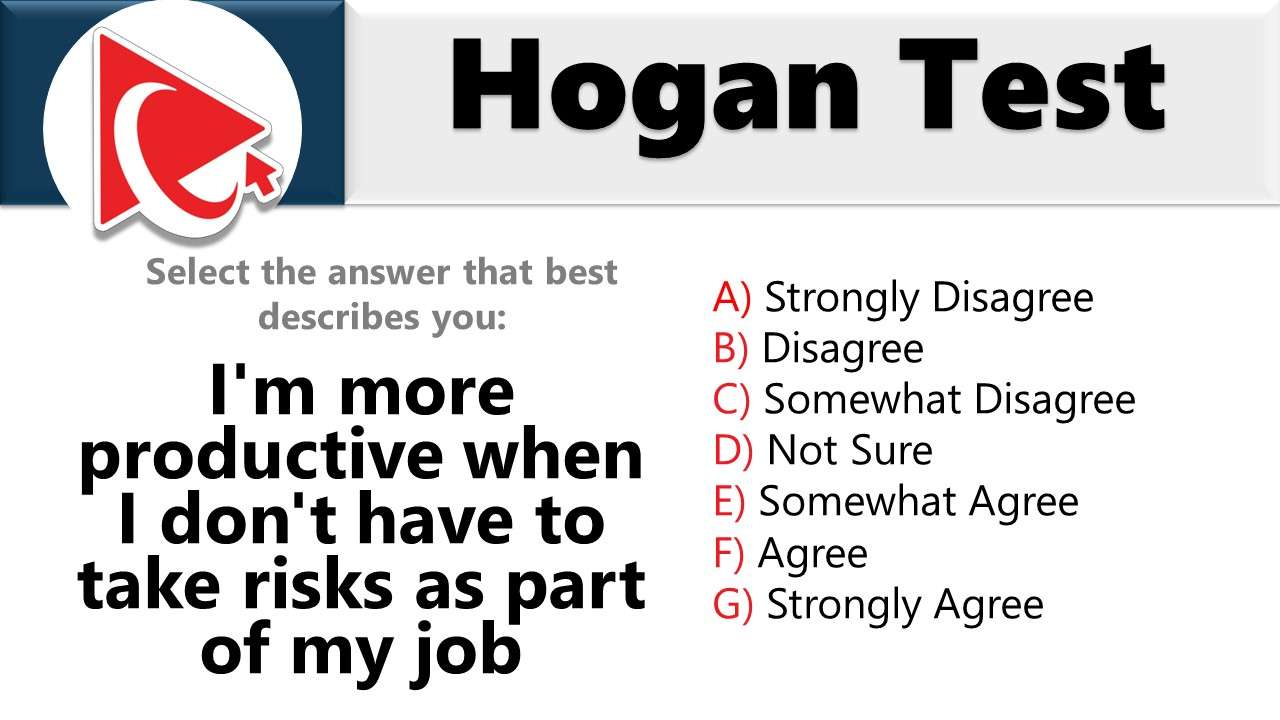
- Test Format: The HPI contains 206 true/false questions completed in 15-20 minutes. Questions are straightforward statements like “I enjoy being the center of attention” or “I prefer to work alone.”
- What It Predicts: The HPI forecasts job performance, leadership potential, and team dynamics. High Adjustment combined with high Ambition predicts executive success. High Sociability with high Interpersonal Sensitivity predicts customer service excellence.
- Sample Question: “I am usually the one who takes charge in group situations.”
This measures Ambition’s Leadership subscale. Answering “true” suggests comfort with leadership roles; “false” indicates preference for supporting positions. Neither is wrong—they predict different career trajectories.
Hogan Development Survey (HDS) – The Dark Side
What It Measures: The HDS identifies 11 derailers—personality characteristics that emerge under stress and can sabotage career success:
- Excitable: Enthusiastic but moody; difficulty maintaining focus
- Skeptical: Cynical, distrustful, sensitive to criticism
- Cautious: Risk-averse, resistant to change, slow decision-making
- Reserved: Socially withdrawn, uncommunicative, emotionally detached
- Leisurely: Independent, passive-aggressive when feeling controlled
- Bold: Overly self-confident, entitled, unwilling to admit mistakes
- Mischievous: Risk-taking, rule-testing, impulsive
- Colorful: Dramatic, attention-seeking, interruptive
- Imaginative: Creative but eccentric, potentially impractical
- Diligent: Perfectionistic, micromanaging, reluctant to delegate
- Dutiful: Eager to please authority, reluctant to act independently
These aren’t disorders—they’re tendencies everyone possesses to varying degrees. Problems arise when scores reach the 90th percentile or higher, indicating potential performance risks.
- Test Format: The HDS presents 168 statements rated on agreement scales, completed in 15-20 minutes. Questions explore how you respond when frustrated, bored, or under pressure.
- What It Predicts: The HDS forecasts leadership failure, career derailers, and interpersonal conflicts. Research shows 75% of leadership failures stem from dark side personality issues, not technical incompetence. A brilliant strategist with high Bold and low Cautious might alienate teams through arrogance. A conscientious manager with high Diligent might bottleneck projects through micromanagement.
- Sample Question: “People would describe me as perfectionistic about my work.”
High agreement suggests Diligent tendencies—excellent for quality control roles, potentially problematic in fast-paced environments requiring delegation.
Motives, Values, Preferences Inventory (MVPI) – The Inside
What It Measures: The Hogan MVPI examines ten core values and drivers that determine cultural fit:
- Recognition: Desire for attention, praise, and public acknowledgment
- Power: Interest in competition, control, and influence
- Hedonism: Focus on pleasure, fun, and work-life balance
- Altruistic: Concern for others, service, and helping
- Affiliation: Valuing relationships, teamwork, and collaboration
- Tradition: Respect for customs, rules, and established methods
- Security: Need for predictability, structure, and stability
- Commerce: Interest in money, profits, and business opportunities
- Aesthetics: Appreciation for quality, design, and self-expression
- Science: Valuing data, analysis, and logical problem-solving
- Test Format: The MVPI contains 200 items completed in 15-20 minutes, asking about preferences and ideal work environments.
- What It Predicts: The MVPI forecasts job satisfaction, retention, and cultural alignment. When personal values align with organizational culture, engagement increases 60% and turnover decreases 50%. Someone high in Science and low in Affiliation thrives in research labs but struggles in relationship-heavy sales roles. Someone high in Altruistic and Affiliation excels in healthcare or education but may feel unfulfilled in purely profit-driven environments.
- Sample Question: “I prefer jobs where I can make a visible difference in people’s lives.”
High endorsement indicates Altruistic values—predictive of satisfaction in non-profit, healthcare, or social service sectors.
Hogan Business Reasoning Inventory (HBRI) – Cognitive Ability
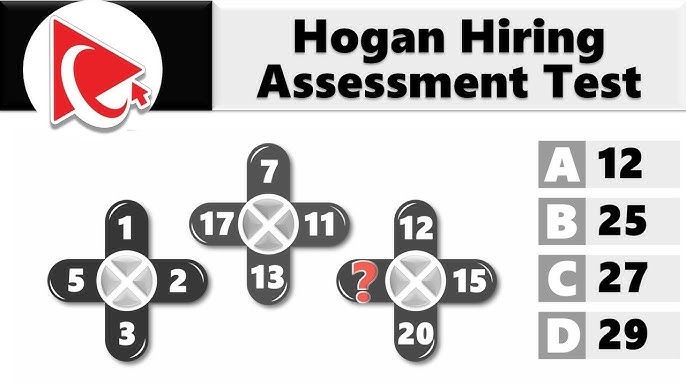
- What It Measures: Unlike personality inventories, the HBRI assesses cognitive problem-solving style and reasoning ability. It distinguishes tactical thinkers (detail-focused, step-by-step problem-solvers) from strategic thinkers (big-picture, conceptual, pattern-recognizers).
- Test Format: The HBRI contains 24 multiple-choice questions completed in 30 minutes. Questions present logical reasoning problems, data interpretation challenges, and scenario-based judgments.
- What It Predicts: The HBRI forecasts learning ability, decision-making quality, and potential for complex roles. Research shows HBRI scores correlate 0.40 with job performance in professional positions—among the strongest predictors available. High scorers learn quickly, solve novel problems effectively, and handle conceptual complexity. Lower scores don’t indicate incapability but suggest preference for concrete, structured work.
- Sample Question: “If all managers are leaders, and some leaders are visionaries, which statement must be true?”
This tests logical reasoning—essential for strategic roles requiring abstract thinking.
How Companies Use Hogan in 2026
Hiring & Selection
Organizations use Hogan assessments for pre-employment screening across all levels. For entry-level positions, the HPI identifies candidates with baseline competencies. For executive selection, companies deploy all four assessments—HPI, HDS, MVPI, and HBRI—creating comprehensive leadership profiles.
The Hogan screening process reduces bias by providing objective data. Rather than relying on “gut feelings” influenced by unconscious preferences, hiring managers compare candidate profiles to validated success benchmarks. This standardization has helped companies improve diversity hiring while maintaining quality standards.
Financial services firms use Hogan to screen for ethical decision-making, using specific HDS patterns to flag potential compliance risks. Technology companies use MVPI to assess cultural fit with fast-paced, innovation-driven environments.
Development Applications
Beyond hiring, Hogan drives leadership development programs. Executives receive detailed feedback reports identifying development priorities. Someone with high Ambition but low Interpersonal Sensitivity might need coaching on stakeholder management. Someone with high Bold on the HDS might need awareness training about soliciting input.
- Coaching and feedback sessions use Hogan results as roadmaps. Rather than generic development plans, coaches create targeted interventions addressing specific behavioral tendencies. The objectivity of assessment data makes feedback less threatening and more actionable.
- Succession planning relies on Hogan to identify high-potential talent. Companies compare internal candidates’ profiles to successful executives, spotting potential leaders years before critical vacancies occur.
- Team building applications analyze collective team profiles, identifying strengths, gaps, and potential conflicts. A team with everyone scoring high in Ambition might need someone with higher Interpersonal Sensitivity to manage relationships.
Industries Leading Adoption
- Financial services leads Hogan adoption, with 85% of major banks using Hogan assessments. The ability to predict ethical decision-making and risk management behavior makes Hogan invaluable in regulated industries.
- Healthcare organizations use Hogan for clinical leadership selection, recognizing that technical medical expertise doesn’t guarantee management success. The HDS particularly helps identify physicians whose clinical excellence might be undermined by interpersonal derailers.
- Technology companies value the HBRI for engineering roles and the MVPI for cultural fit assessment. Fast-scaling startups use Hogan to maintain culture while growing rapidly.
- Manufacturing relies on Hogan for safety-critical positions, using specific scale combinations to predict compliance with safety protocols.
Understanding Your Hogan Results
How Scores Work
Hogan uses percentile rankings, meaning your score reflects how you compare to normative samples. A score at the 70th percentile means you scored higher than 70% of the comparison group.
Crucially, there’s no universal “pass” or “fail.” A high score isn’t automatically better. High Ambition predicts leadership success but might create conflict in collaborative roles. High Prudence ensures reliability but might indicate inflexibility in dynamic environments.
Job-family specific benchmarks mean your scores are interpreted relative to successful performers in similar roles. The optimal profile for accountants differs from sales professionals, and Hogan reports reflect these distinctions.
The Seven HPI Scales Decoded
Adjustment (Emotional Stability):
- High scores (70-90th percentile): Calm under pressure, resilient, even-tempered. Optimal for crisis management and high-stress roles.
- Low scores (10-30th percentile): More emotional responsiveness, passion, intensity. Can drive urgency but may struggle with sustained pressure.
Ambition (Drive and Leadership):
- High scores: Competitive, assertive, leadership-oriented. Excellent for management but may overwhelm peers.
- Low scores: Supportive, cooperative, modest. Strong team players who may need encouragement to lead.
Sociability (Extraversion):
- High scores: Outgoing, talkative, energized by interaction. Perfect for sales, networking, public-facing roles.
- Low scores: Reserved, prefer working independently. Excel in analytical, research, or technical roles.
Interpersonal Sensitivity (Tact and Perceptiveness):
- High scores: Diplomatic, empathetic, politically aware. Essential for relationship management and negotiation.
- Low scores: Direct, frank, results-focused. May inadvertently damage relationships despite good intentions.
Prudence (Conscientiousness):
- High scores: Organized, dependable, rule-following. Critical for compliance, quality control, and detail-oriented work.
- Low scores: Flexible, spontaneous, innovative. May excel in creative roles but struggle with structure.
Inquisitive (Curiosity):
- High scores: Creative, imaginative, intellectually curious. Drives innovation and continuous improvement.
- Low scores: Practical, focused on proven methods. Ensures consistency and operational efficiency.
Learning Approach (Continuous Development):
- High scores: Values education, stays current, seeks knowledge. Predicts adaptability in changing environments.
- Low scores: Relies on experience, practical wisdom. May resist training programs or academic approaches.
Reading Your Report
Hogan reports present multiple levels of detail:
- Primary scales provide the big-picture personality overview across the seven HPI dimensions.
- Subscales offer granular insights. For example, within Ambition, you’ll see separate scores for Competitive, Self-Confidence, Leadership, Identity, and No Social Anxiety.
- Occupational scales are job-specific combinations. The “Service Orientation” scale combines elements of Adjustment, Interpersonal Sensitivity, and low Ambition—optimal for customer service excellence.
- Development recommendations suggest specific behavioral adjustments based on your profile and target role. These aren’t vague suggestions but concrete actions: “Practice soliciting input before making decisions” or “Develop tolerance for ambiguity in fast-changing situations.”
How to Prepare for the Hogan Assessment
Understanding the Approach
The most important preparation insight: authentic answering produces better outcomes than “faking good.” The Hogan personality test includes validity scales detecting inconsistent response patterns. Trying to appear perfect triggers red flags that invalidate results or raise concerns about authenticity.
The consistency requirement means you can’t strategically answer individual questions. The assessment asks similar questions multiple ways, and contradictory answers reveal dishonesty or careless responding.
Preparation Strategies
- Research the role requirements: Understand what success looks like in the target position. Review the job description, talk to current role holders, and identify critical behavioral competencies.
- Understand what “success” looks like: If applying for a collaborative team role, understand that moderate Ambition with high Interpersonal Sensitivity might outperform extreme Ambition. If pursuing executive leadership, recognize that high Adjustment and Ambition predict effectiveness.
- Practice authentic self-assessment: Spend time honestly evaluating your behavioral tendencies. How do you actually respond under stress? What genuinely motivates you? Self-awareness produces more accurate, strategically aligned responses.
- Review common scales: Familiarize yourself with the seven HPI scales, 11 HDS derailers, and 10 MVPI values. Understanding the framework helps you recognize what questions assess.
- Take practice tests: Several vendors offer Hogan practice assessments. While questions won’t match exactly, practice builds comfort with format and pacing.
- Manage time effectively: With 15-20 minutes for 200+ questions, you’ll average 5-6 seconds per item. Practice quick, intuitive responding rather than overthinking.
Common Mistakes to Avoid
- Trying to appear perfect: Answering every question in the most socially desirable direction triggers validity concerns. Nobody is maximally ambitious, sociable, prudent, and inquisitive simultaneously—that profile signals dishonesty.
- Inconsistent answering: Contradicting yourself between similar questions invalidates results. If you claim to “enjoy taking charge” but also “prefer others to lead,” the assessment flags inconsistency.
- Rushing through questions: While pacing matters, careless speed produces random response patterns. Read each question fully before answering.
- Ignoring job context: Answer as you naturally behave in professional settings, not personal life. Your workplace reputation matters more than your weekend personality.
Practice Resources
- Free practice questions: JobTestPrep and AssessmentDay offer limited free Hogan-style questions introducing format and content.
- Prep courses: Comprehensive programs from TestPrep-Online and Practice4Me provide hundreds of practice items with explanations.
- Study guides: Books like “The Essential Guide to Hogan Assessments” explain the theoretical framework and interpretation.
Remember: preparation should enhance authentic self-presentation, not enable misrepresentation.
Success Stories: How Hogan Predictions Work
A global pharmaceutical company implemented Hogan assessments for sales leadership selection. Before Hogan, leadership failure rates exceeded 40% within two years. After implementing validated selection profiles—specifically targeting high Adjustment, moderate Ambition, and high Interpersonal Sensitivity—failure rates dropped to 12%. The specific HDS pattern they screened for (avoiding high Bold combined with low Prudence) eliminated candidates prone to ethical shortcuts.
A technology startup used MVPI during rapid scaling to maintain cultural fit while tripling headcount. By identifying candidates with high Science, low Tradition, and moderate Security, they preserved their innovation culture despite explosive growth. Eighteen-month retention improved from 67% to 89%, saving millions in replacement costs.
An international hotel chain deployed Hogan for general manager selection across 300 properties. Using property performance data, they identified the optimal profile: moderate Adjustment (calm but responsive), high Ambition (driven), high Interpersonal Sensitivity (guest-focused), and high Prudence (operationally sound). Properties led by managers matching this profile showed 23% higher guest satisfaction and 31% better financial performance.
These aren’t isolated successes—meta-analyses show organizations using validated assessments see 20-40% improvement in selection quality, translating to millions in productivity gains and reduced turnover costs.
Criticisms & Limitations
Common Concerns
- Can personality tests really predict performance? Critics argue that situational factors outweigh personality. While context matters, meta-analyses confirm personality predicts 10-20% of performance variance—substantial impact for a 20-minute assessment.
- Privacy considerations: Some candidates feel uncomfortable with psychological assessment, viewing it as invasive. Organizations must balance selection effectiveness against candidate experience.
- Cultural bias questions: Early personality assessments showed cultural validity problems. Critics question whether Western-developed models apply universally.
Also Read! Is Your Monthly Rent Payment a Variable Expense? Here’s the Truth
Hogan’s Response
Hogan addresses validity concerns through continuous validation research demonstrating consistent prediction across hundreds of studies. The criterion-related validity evidence—showing actual job performance correlates with predicted performance—remains robust.
For cultural concerns, Hogan maintains international norming groups, ensuring scores are interpreted relative to culturally appropriate comparison samples. Assessments have been validated in diverse cultures across Asia, Europe, Africa, and South America.
The system undergoes continuous improvement, with updated norm groups every few years and ongoing research into emerging workplace dynamics. Recent additions include remote work performance prediction and digital leadership competencies.
Hogan vs. Other Assessments
| Assessment | Type | Primary Use | Validity | Workplace Focus |
|---|---|---|---|---|
| Hogan Assessment | Personality (reputation-based) | Predicting job performance, leadership, cultural fit | High (0.30-0.40) | Specifically designed for workplace prediction |
| Myers-Briggs (MBTI) | Personality (type-based) | Self-understanding, team building | Low (0.10-0.20) | General personality, not performance-focused |
| DISC | Behavioral style | Communication preferences, team dynamics | Moderate (0.15-0.25) | Behavioral tendencies, limited performance prediction |
| StrengthsFinder | Strengths identification | Development, engagement | Low-Moderate | Identifies talents, not comprehensive personality |
| Big Five | Personality traits | Research, general assessment | Moderate-High (0.20-0.35) | Academic foundation but less workplace-specific |
| PI Behavioral Assessment | Behavioral drives | Hiring, development | Moderate-High (0.25-0.35) | Workplace-focused but shorter assessment |
Why Organizations Choose Hogan
- Predictive validity: Hogan consistently demonstrates higher validity coefficients than alternatives, translating to better hiring decisions.
- Workplace-specific design: Unlike general personality tests adapted for work, Hogan was built specifically to predict workplace behavior and job performance.
- Scientific foundation: Four decades of validation research, published studies, and continuous improvement based on real workplace data sets Hogan apart.
- Comprehensive coverage: The combination of HPI, HDS, MVPI, and HBRI provides 360-degree personality assessment—bright side, dark side, values, and cognitive ability—unmatched by competitors.
FAQs
How accurate is the Hogan Assessment?
The Hogan personality assessment achieves validity coefficients of 0.30–0.40 for predicting job performance, considered excellent in psychological measurement. This translates to a 20–40% improvement in hiring quality compared to unstructured interviews alone.
Can you fail a Hogan Assessment?
No—there’s no pass/fail. Scores are compared to successful performers in specific job families. A profile mismatched to one role might be optimal for another.
How long does the Hogan test take?
Each assessment (HPI, HDS, MVPI) takes 15–20 minutes. The HBRI requires 30 minutes. A complete battery takes approximately 75–90 minutes.
Can you retake the Hogan Assessment?
Organizations typically require 6–12 months between administrations, as personality remains relatively stable. Retaking immediately won’t significantly change results.
How much does the Hogan Assessment cost?
Individual assessments cost $60–$150 depending on which tests are included. Organizations typically pay $200–$400 for complete batteries including interpretation reports.
Is the Hogan used for hiring or development?
Both. Approximately 60% of Hogan assessments support pre-employment screening; 40% drive leadership development, coaching, and succession planning.
What happens if you’re dishonest on the Hogan exam?
Validity scales detect inconsistent response patterns. Extreme impression management flags results as potentially invalid, requiring retesting or disqualification.
How long are Hogan results valid?
Personality remains relatively stable, so results stay relevant for 18–24 months. Major life changes or significant development may warrant reassessment.
Conclusion: The Future of Workplace Prediction
The Hogan Assessment remains the gold standard for predicting workplace success because it measures what matters: reputation and behavioral patterns others experience.
As organizations navigate hybrid work, leadership shortages, and retention challenges in 2026, scientifically validated tools that predict performance, culture fit, and leadership potential become increasingly valuable.
Understanding your Hogan profile isn’t just about landing jobs—it’s about finding roles where your natural tendencies drive sustainable success and genuine satisfaction.
About the Author